

Kostenloses Gartner®
Hype Cycle™ for Container Technology
Published 02 Jul 2026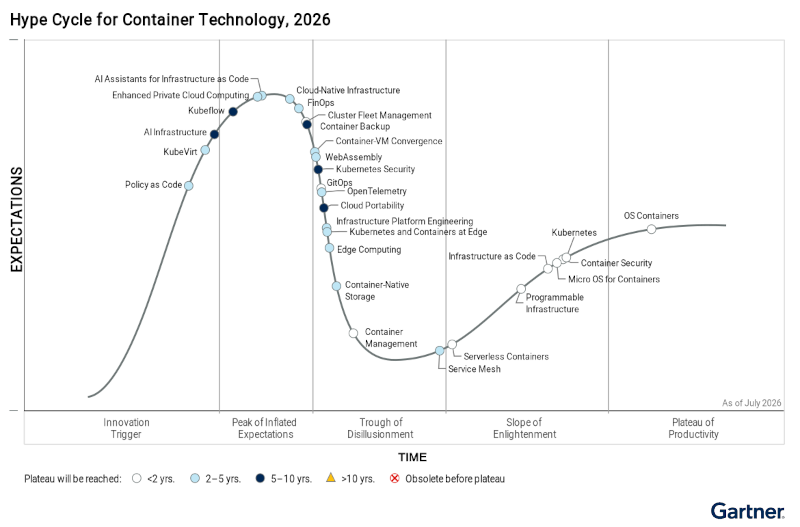
Container technology has moved well past the experimental phase, but knowing which capabilities are mainstream-ready versus still emerging is exactly what separates a confident infrastructure roadmap from a reactive one.
This year's Gartner® Hype Cycle™ for Container Technology evaluates the maturity of the technologies shaping modern infrastructure and IT operations: from container-VM convergence to AI-driven infrastructure automation. Kubermatic is named as a Sample Vendor in this year's report, specifically under Container-VM Convergence, one of the categories we believe Gartner tracks as foundational to modern infrastructure strategy.
Download the full report to see where container-VM convergence, policy-as-code, and we think Kubernetes-based virtualization sit on Gartner 2026 maturity curve, and how Kubermatic fits in.
What's inside
- The full Priority Matrix, evaluating each technology's benefit rating against its expected years to mainstream adoption
- The complete Hype Cycle™ curve, showing where each technology sits, from Innovation Trigger through the Plateau of Productivity
- Deep-dive analysis on categories including Container-VM Convergence, KubeVirt, and Policy as Code (PaC)
- Gartner recommendations for infrastructure and operations leaders evaluating these technologies today
Häufig gestellte Fragen
Last updated: August 2026
What is the Gartner® Hype Cycle™ for Container Technology?
Container technologies empower digital initiatives to deliver value. Container management technologies such as Kubernetes increasingly serve as the foundational infrastructure for deploying and scaling AI workloads. Furthermore, AI is starting to enhance container management operations themselves. Heads of infrastructure and IT operations should view these technologies as enablers of broader trends in AI, DevOps, cloud computing and engineering-driven approaches to operations.
What is a Gartner® Hype Cycle™?
Clients use Hype Cycles to get educated about the promise of an emerging technology within the context of their industry and individual appetite for risk.
Is Kubermatic named in the Gartner® Hype Cycle™ for Container Technology, 2026?
Yes. Kubermatic is named as a Sample Vendor under the Container-VM Convergence category in the Gartner® Hype Cycle™ for Container Technology, 2026.
Kubermatic Virtualization (KubeV), built on the open-source KubeVirt project, is designed to run VMs and containers together on one Kubernetes-native platform, giving organizations a single operational model, a single control plane, and a single set of automation tools for both workload types.
What is Container-VM Convergence?
Container-VM Convergence is a category covering technologies that let organizations run virtual machines and containers on a single Kubernetes-based infrastructure layer, instead of operating separate VM and container stacks. It's relevant to organizations consolidating infrastructure or evaluating alternatives to VMware.
What is KubeVirt?
KubeVirt is an open-source project that runs virtualized workloads natively on Kubernetes. The Gartner® Hype Cycle™ for Container Technology, 2026 evaluates KubeVirt as a technology enterprises are increasingly evaluating for infrastructure modernization and VMware alternative strategies.
How does Kubermatic relate to KubeVirt?
Kubermatic Virtualization (KubeV) is built on KubeVirt. It lets organizations run VMs and containers on one Kubernetes-native platform, which we believe is the same infrastructure consolidation approach Gartner describes under Container-VM Convergence in its 2026 Hype Cycle™ report.
Who is the intended audience for this report?
Gartner provides insights in the Hype Cycle™ for Container Technology for infrastructure and operations leaders, including Heads of IT/Operations, platform architects, and infrastructure teams evaluating container-VM consolidation, virtualization modernization, or AI infrastructure readiness.
Gartner, Hype Cycle™ for Container Technology, Dennis Smith, 02 July 2026
GARTNER is a registered trademark and service mark of Gartner, Inc. and/or its affiliates in the U.S. and internationally and is used herein with permission. All rights reserved.
Gartner does not endorse any vendor, product or service depicted in its research publications, and does not advise technology users to select only those vendors with the highest ratings or other designation. Gartner research publications consist of the opinions of Gartner's research organization and should not be construed as statements of fact. Gartner disclaims all warranties, expressed or implied, with respect to this research, including any warranties of merchantability or fitness for a particular purpose.


